
Frozen Assets
Melting ice opens new trade routes, Britain's first rice harvest, and Trump bails out Milei — and James Meadway is back!
Hello listeners/readers,
Welcome back to THE FIX, the monthly newsletter from MACRODOSE. Apologies this “September” edition finds you slightly late – we’ll be back to our usual scheduling later this month!
James Meadway is back! After a summer spent working on his new book, James makes his long-awaited return to the MACRODOSE hotseat this week. And in true back-to-school spirit, we’re kicking things off with a rapid-fire tour of the stories you might have missed.
Today’s show begins with a quick skim through the usual churn of geopolitical headlines - from Europe’s rush to rearm, to the much-touted UK-US “Tech Prosperity Deal”, before turning to some under-the-radar stories of the summer, those that really reveal how climate and capitalism are colliding.
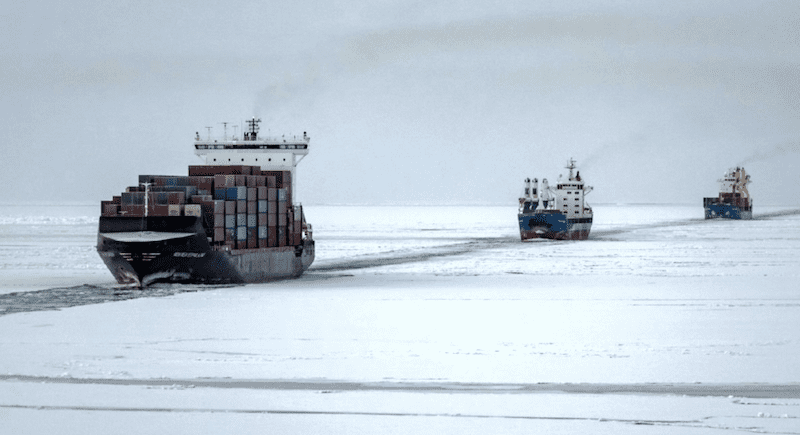
From England’s first-ever rice harvests, to new Siberian shipping routes carved out by retreating Arctic ice, and Trump’s bailout of libertarian Javier Milei in Argentina, we map out how ecological and geological ruptures are reshaping our global economy.
As James argues, it’s only by connecting these dots – and seeing how the climate crisis underpins our current political turmoil – that we can look beyond the headlines, and start building a new economy fit for the challenges of the 21st century.
James’ new book, provisionally titled The Natural Economy, is due out next year with Allen Lane.
In other news, we’re excited to announce Overshoot: Navigating a World Above 1.5C, a new four-part series from the team that produce MACRODOSE!
Overshoot is an audio documentary hosted by climate researcher Laurie Laybourn, and brought to you by Planet B Productions in collaboration with the Strategic Climate Risk Initiative.
Beginning in 2015, with the Paris Agreement to limit global heating to 1.5°C above pre-industrial levels, Overshoot tells the story of a world ten years on, as temperatures spiral upwards and climate chaos wreaks havoc across the globe. The series asks: how did we end up here and how do we navigate what comes next?
It’s a must-listen, and we highly recommend you check it out. Listen to the trailer now on the MACRODOSE feed and to the first episodes from Monday 6th October. For essays and bonus content, sign up at overshootpod.com or follow @overshootpod on social media.
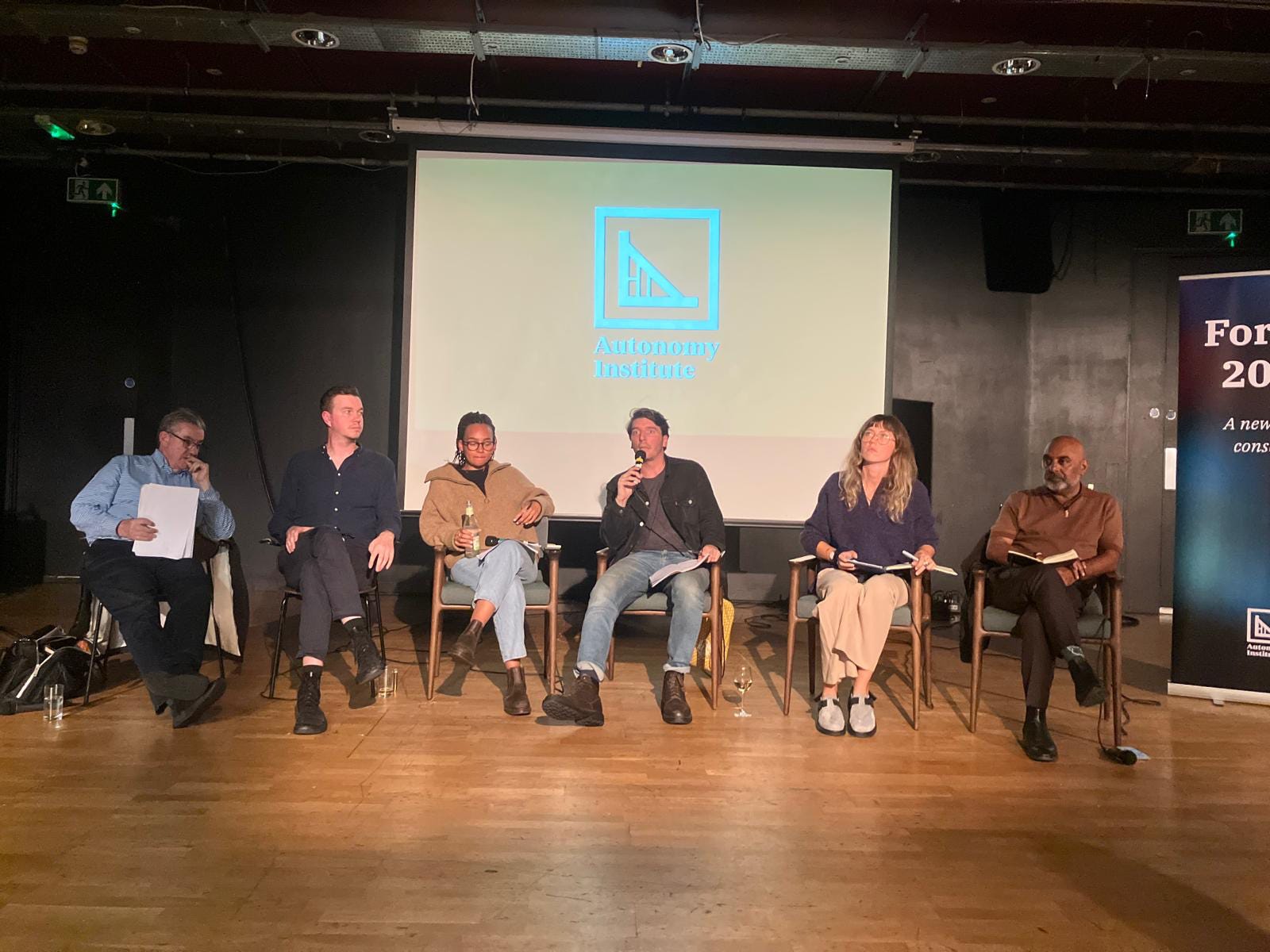
Finally, just a quick note to say thank you to everyone who attended our live show, hosted by the Autonomy Institute at Oxford House on 17th September.
The panel discussed progressive politics and policies they’d like to see implemendted in Britain – featuring James Schneider (Progressive International), Asad Rehman (Friends of the Earth), John McTernan (political strategist and commentator), Ayeisha Thomas-Smith (NEON), Antonia Jennings (Centre for London). Listen to the full discussion here:
▦ Where Capital and Nature Meet
(A note from our friends at the BREAK—DOWN)
Our friends over at the BREAK—DOWN have just dropped ISSUE #2. In the second issue, writers approach to the idea of ‘frontiers’ in the climate crisis from many perspectives, sending reports from the frontlines of extractive industries, exploring new avenues of risk and resistance, and showing, in the words of contributor (and former MACRODOSE guest) Thea Riofrancos, how frontiers are “never exhausted by the economic and political imperatives that designate them as such. They exceed them.”
Read an extended excerpt below from Thea’s conversation with editor, Adrienne Buller and subscribe for free, to read the full piece on the BREAK–DOWN’s website:
AB: Your latest book, ‘Extraction: The Frontiers of Green Capitalism’ focuses largely on lithium, but you also reference several other minerals—copper, cobalt, yttrium—all of which fall within various designations like “critical” or “strategic” or “rare earth”.
Could you explain the significance of these designations? What do they really mean, where do they come from, and what or whose purposes do they serve?
TR: It can be counterintuitive to make the argument that words and language and definitions really matter when we’re talking about the hard materiality of extraction. Why care about these floating signifiers when we’re looking at something as physical as a mine or an ecosystem or a watershed?
But the political languages we use not only reflect balances of power, they can also create political opportunities. This is particularly clear in the case of extractive sectors. As you just named, there are a lot of different definitional categories.
These are often precisely defined somewhere, in, say, the technical compendium of a government report. But in practice they’re also thrown around very loosely, and this is itself both politically pragmatic and very productive for the actors that do it. In other words, the malleability of these terms in their practical usage turns out to be politically important.
“Critical minerals” are the broadest category, describing, at least in the US government’s definition, those minerals considered essential for economic functioning and/or national security. And—this second clause is important—to be critical they must also be subject to some supply vulnerability, whether geologically or in terms of market availability. It could be that supply is really concentrated, such that a few specific countries “control” the supply. Or it could be that there are disruptions to the supply—for instance, what’s happening right now in the Red Sea with the Houthis’ interventions or in terms of the longer history of the Suez Canal. As you can tell from the definition, there’s a lot of room for interpretation regarding which minerals count as “critical”, and so we tend to get a growing roster, whereby every time a new economic sector or activity gets a certain status in the broader economy, like the energy transition or even AI, then all the minerals necessary for, say, solar panels, or for lithium batteries, or for transmission lines—all of those minerals would make it onto the list. Hence, lithium joined the US critical minerals list in 2018.
The origins of this terminology are important, and they help explain this conflation of what’s important for national security and what’s important for the broader economy. The designation used to be “strategic and critical minerals”, and the origin of the US even keeping a list like this dates to the lead-up to World War II. During the war itself, the US government intervened directly to ensure supplies of all such minerals relating to military applications.
So that’s all to say that the very idea of keeping a list of what minerals are “critical” or “strategic” has a bellicose origin, and that applies both in terms of certain economic realms being deemed essential to national security, as well as in a tactical sense: if this is so important, we might use military means to acquire it. Both of those senses adhere in the concept of critical minerals. And even in the contemporary context or when we’re just talking about green technologies, there’s a trace of this origin that is important to acknowledge.
Rare earths are a subset of critical minerals. They are a set of 17 elements with some chemical similarities to one another. There are two important things to bear in mind here. The first is that lithium is not a rare earth, and the second is that rare earths are not rare. Rather, they were thought to be rare when they were first discovered in the 18th century, and the name stuck. While not rare geologically, there’s a lot of technical difficulty and therefore environmental impact in how you extract and separate them. They have also been in the news recently due to US-China geopolitics concerning their supply, as several are essential both for the energy transition, semiconductor or military technologies.
In terms of supply, lithium is really geologically abundant, and I make sure to always say that because the term “critical minerals” can trick us into thinking something is scarce.
These definitions matter, and whether they’re called “strategic” materials or minerals, as they are in China, or critical minerals in the US—if a government sees that it’s important to keep such a list, it’s because they want to ensure access, whether domestically or abroad. They might want to securitize the supply chains that produce them. New forms of government support, promotion, financing, and protection tend to ensue.
These state interventions are a boon for the private sector because they form a clear signal that the government of whatever place wants to make sure this mineral is extracted, which might mean subsidies for the private sector, might mean tax breaks and other forms of financial backstopping. The language of critical minerals is in this sense performative: it creates new social facts on the ground with real material consequences.
AB: Before picking up on a few of those points, I have a scene setting question: where around the world is lithium mined? And which regions, particularly areas that you focus on like Chile, are seen as the future frontiers of production, with all the potential conflicts this implies?
TR: I’ll start by explaining why lithium is considered a critical mineral. Lithium is currently the essential element in lithium-ion batteries, which are, for now, the main modality through which we will decarbonize ground transportation as well as store energy on electricity grids that rely on renewable and thus intermittent sources.
In terms of supply, lithium is really geologically abundant, and I make sure to always say that because the term “critical minerals” can trick us into thinking something is scarce. However, despite its geological abundance, there are only four countries that are considered the main lithium producers— Australia, Chile, China, and Argentina, in that order—which, already, pings that alert system regarding concentration of supply and supply chain vulnerability, particularly when China is one of those four.
While we have four top producers and exporters of lithium, there are others rising in the ranks of global production. And, importantly, China is working to increase its domestic production, where it has previously been more of an asset seeker with regards to lithium, meaning it has invested in mines elsewhere in the world or has been a major importer.
AB: You note in your book that China has become dominant in this space, not only when it comes to securing lithium, but also farther along the supply chain, where the country accounts for some 85 per cent of global battery manufacturing capacity.
I’m interested in how they’ve achieved this, and in what ways this huge success shapes the response of countries in the Global North. You speak in the book about geostrategic competition or security concerns. But you also highlight the return of industrial strategy and non-free-market policies in places previously hostile to anything but market approaches, whether it’s the US or EU. With these major shifts in mind, to what extent is lithium reshaping how global capitalism functions and what it looks like?
TR: It’s hard to overstate how much of a lead China has had on the entire political economy of new energy technologies, of which lithium batteries are a particularly important component.
Lithium mining in China goes back to the mid-20th century, when lithium was being used for things like nuclear weaponry and other industrial applications. As early as the mid-1980s, the Chinese Communist Party pivoted to thinking about what were called, at the time, “advanced energy technologies”. It’s interesting to think about that moment because this is a little over a decade after the so-called West was also thinking about advanced energy technologies as a reaction to the oil crisis of the early 1970s, which propelled lots of exploration around alternatives to oil. However, in typical fashion those plans were all kind of scuttled as soon as the oil market stabilized.
In 1986, as a result of the advocacy of a group of Chinese scientists, Deng Xiaoping established the “863 Program” to encourage the development of “advanced technologies” across multiple fields, including energy.
In China, the pivot to advanced technologies opened up new realms of state planning. In 2001, before they were really being discussed in the Global North much at all, electric vehicles (EVs) were included in a five year plan the first time. This meant the entire toolkit of industrial policy and state planning, as well entrepreneurialism and private sector investment, were directed at EV and battery manufacturing. We don’t really have a recent correlate for this level of state coordinated economic activity in the West. We’d have to go back to World War II to look for an equivalent.
China employed a combination of state planning, state financing, state owned enterprises and collaboration with the private sector to produce the situation in which China now has 85 per cent of global lithium-ion battery production capacity, which is just an astounding figure for any product, but particularly for a product deemed so essential to global economic functioning and to the energy transition. How did they do it? The range of tools is huge: state subsidies; various forms of capital discipline; contests between major Chinese cities; some real disciplining of consumer behaviour, offering rebates for consumers that were quite generous, but also scaling back those rebates as EV companies in China got more efficient in their manufacturing processes so that the consumer rebates were no longer needed. The Chinese Communist Party (CCP) has been, I think, really intelligent about how to deploy both carrots and sticks, how to induce capital investment and consumer consumption and how to discipline both of those to get them towards a stated goal of electrifying the transportation sector writ large.
How does the West respond to this? Extremely hypocritically. On the one hand, they are just beyond impressed, which makes them quite scared of how rapidly and effectively China has managed to dominate what has become a critical sector for the global economy. It’s a bit like they got caught sleepwalking into the 21st century. We should also remember that in places like the US, Germany and Japan, the automotive sector has not only a lot of economic weight, but also a lot of political importance. It’s not just any old industry, so to lose that sector to a foreign competitor has implications beyond the directly economic impact.
Where the West became hypocritical was in asserting that China has achieved this in the wrong ways: they have done “communism”, they have done “planning”, they have done “market manipulation,” they have done “trade distortion”. They’re publicly very critical of the way that China has become the winner, and at the same time they’re copying it—copying it but not doing it as well: we’re going to do tariffs. We’re going to do industrial policy. We’re going to do market and trade interventions. But also, because we haven’t laid the groundwork for this in an intelligent way, we’re going to do it poorly.
It’s interesting to see this new debate around industrial policy, but it’s tragic and problematic that it is so enmeshed in geopolitical competition when there could be, in another world, a more collaborative approach that borrows technological innovation across borders, and thinks about cooperative governance strategies for the raw materials themselves.
Subscribe to the BREAK–DOWN for free to unlock the full conversation with Adrienne and Thea now.
Or get a paid subscription to the BREAK—DOWN to unlock all the articles from ISSUE #2 and the BREAK–DOWN’s entire archive!
▦ FURTHER READING
(A list of sources, recent articles and essential reading.)
Read: “China will drop its claim to benefits available to developing countries in trade negotiations under the WTO in a move that follows long-standing US objections to the practice.” [Financial Times]
Read: A Russian news report on the geoengineering of Siberan rivers to export critical minerals [TASS]
Read: The loss of Arctic sea ice, driven by global warming, has made the Polar region increasingly accessible. Last week, China launched its first container ship service to Europe via the Polar region, halve express shipping times between the two locations. [Seatrade Maritime] [Reuters]
Read: Jacob Bolton maps the spectre of Polar shipping lanes. [BREAK—DOWN]
Read: An farm has successfully grown rice for the first time in the UK, as part of a trial that looks to find how we can produce enough food and protect farmer’s livelihoods in a world being altered by climate change. [BBC News]
Listen: Adam Tooze examines how Trump is reshaping U.S. policy toward Latin America and its economic impact on Argentina, Venezuela, and Mexico. [Ones and Tooze]
Listen: Daniel Denver is joined by Alberto Toscano and Stuart Schrader to discusse Trump’s intensification of police, ICE, and military repression. [The Dig]
Caught something we missed? Let us know what you’ve been reading/watching/listening to this month down in the comments?
▦ BOOK CLUB
(A deeper dive into topics covered on the show.)
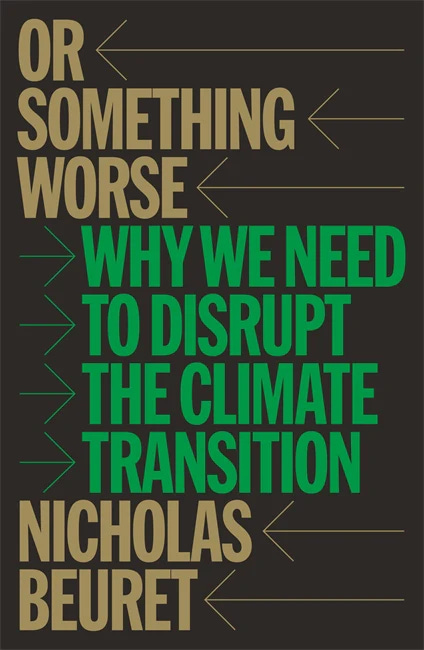
Or Something Worse: Why We Need to Disrupt the Climate Transition by Nicholas Beuret
Or Something Worse exposes the bleak realities of the transition to a carbon-neutral economy. Greening the economy has become a one-sided war, as governments and businesses squeeze the living standards of ordinary people. We need to seize control of the transition in order to reshape it to equitable ends.
Nicholas Beuret follows those already fighting back through ‘don’t pay’ campaigns, blockades of fossil-fuel infrastructure, and community counter-planning. He shows we have the tools not only to stop climate change but to build a fairer future.
Find the MACRODOSE ESSENTIALS reading list over on our bookshop.org page here, along with book suggestions from past guests on the show. You’ll also be able to buy the books from the list AND at the same time support the show - for every book you buy via our reading lists, bookshop.org gives us 10%. Treat yourself and stock up on some new additions to your bookshelf!
▦ MERCH
Check out what we’ve got in stock over on the MACRODOSE merch store here. As a special thank you, we’re offering subscribers 15% off our merch. Use the code MACRO15 at the checkout.

Every purchase helps support the podcast and ensures we can keep delivering insights and analysis in 2025. Together we are building a new era of independent, people-powered economics media!